


Rome is the city with the highest number of obelisks in the world: no fewer than 13, between original Egyptian monuments and Roman imitations - more than Egypt itself preserves today. Up to 3,500 years old, transported across the Mediterranean, toppled, buried and raised again - their story is Rome's own story.
BC The oldest
Predominantly Egyptian, these extraordinary monuments were shipped to the Eternal City at the behest of the emperors of the early centuries AD, often aboard specially constructed vessels - logistical feats remarkable even by modern standards.
Some obelisks were instead crafted in the Roman era from the same pink granite quarried at Aswan as the Egyptians used, either left blank or inscribed with hieroglyphs copied - not without errors - from Pharaonic originals. A revealing curiosity: the Roman stonemasons had no idea what the signs they were carving actually meant, making these "fakes" an extraordinary record of how Rome looked upon Egypt with admiration and, at the same time, cultural superficiality.
In Egypt, obelisks held a deep religious meaning, celebrating the divinity of the Pharaoh - they were regarded as petrified rays of sunlight, sacred to the god Ra. In Rome, transformed into symbols of power and conquest, they were used to adorn circuses, temples and tombs, with the original inscriptions entirely disregarded.
The Lateran - The Oldest and the Tallest

The oldest and tallest obelisk in Rome, it is also the tallest Egyptian obelisk still standing in the world: 32.18 metres without its base, 45.70 metres with the pedestal, approximately 230 tonnes of red Aswan granite. It originally stood before the Temple of Amun at Karnak: begun by Pharaoh Thutmose III and completed by his nephew Thutmose IV (15th century BC).
In 357 AD, Emperor Constantius II - having a special ship built for the transport - had it placed at the centre of the Circus Maximus. It fell during the Middle Ages and was brought to light in 1587 in three pieces, reassembled at the behest of Sixtus V.
The Flaminio - Piazza del Popolo
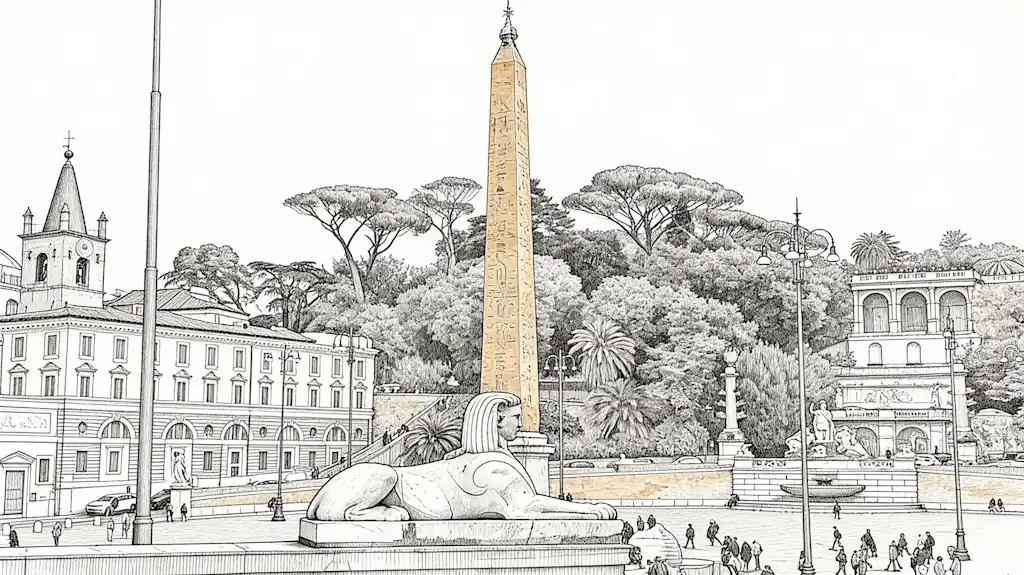
The second oldest in Rome (23.91 m, 36.43 m with its base), it was brought to Rome by Augustus in 10 BC directly from Heliopolis as a trophy of Egypt's conquest following his victory over Mark Antony and Cleopatra. It adorned the Circus Maximus alongside the Montecitorio obelisk. Both fell into ruin after the circus was abandoned and were restored and re-erected by Sixtus V at the end of the 16th century.
The Vatican - St Peter's Square
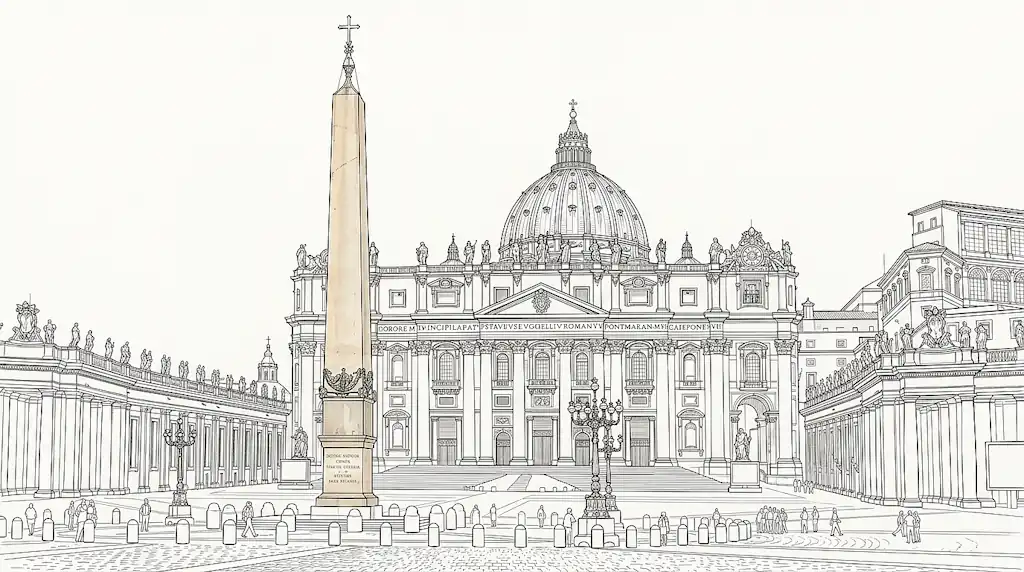
Rome's most famous obelisk, standing at 25.46 m (40.28 m with base and cross), it is the only one never to have fallen in the Middle Ages - standing uninterrupted for about 1,500 years. Emperor Caligula had it transported from Heliopolis in 37 AD to adorn the Circus of Nero.
The colossal ship built for the transport - the largest ever launched for a monument in antiquity - never returned: deliberately sunk with over 1,000 tonnes of ballast and pozzolana, it became the foundation of the islet on which the lighthouse of Claudius's harbour (Portus Romae) was built, similar in concept to the lighthouse of the port of Leptis Magna in present-day Libya.
The Campense - Augustus's Sundial
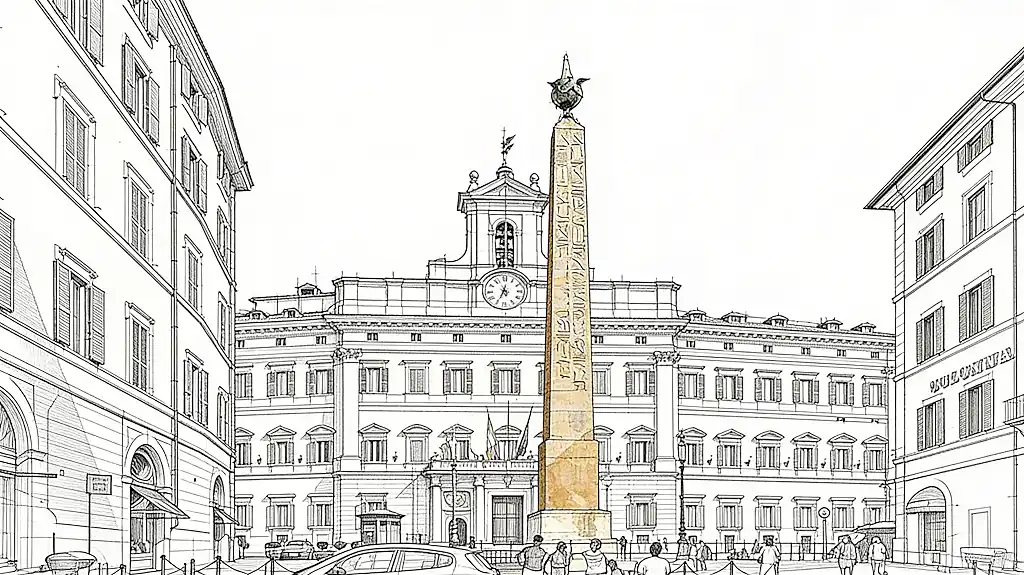
From the reign of Pharaoh Psamtik II (6th century BC), it was brought to Rome by Augustus to serve as the gnomon of a vast sundial designed by Agrippa: the obelisk was positioned so that its shadow fell on the exact centre of the Ara Pacis on the emperor's birthday. An urban-scale solar clock - one of the largest ever built in antiquity.
The Obelisks of the Iseum Campense
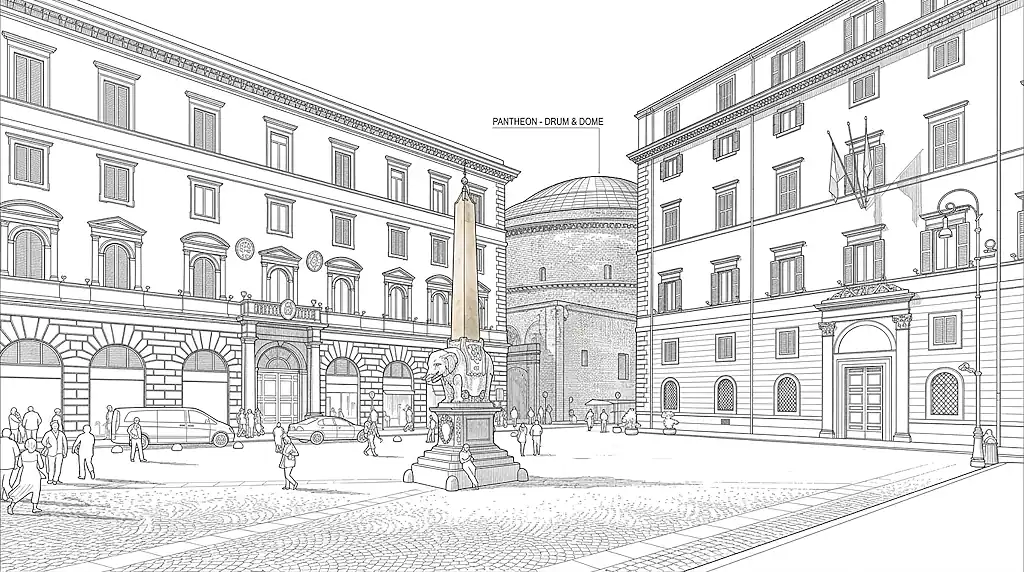
A number of small obelisks - roughly 4.5 to 6 metres tall - come from the Iseum Campense, the magnificent Temple of Isis and Serapis in the Campo Marzio. Nothing remains of this imposing complex but its memory, yet its obelisks have been relocated to the centres of Rome's most iconic squares.
One of them is the famous "Pulcin della Minerva": the small elephant designed by Bernini in 1667 that carries a Ramesside obelisk behind the Pantheon. The elephant was chosen as a symbol of wisdom - capable of bearing the weight of antiquity. Across from the Pantheon, a second obelisk of the same origin - also dating to Ramesses II (1279-1213 BC) - presides over a late-Renaissance fountain.
Less well known is the small obelisk of Villa Celimontana on the Caelian Hill, once part of the private collection of the Mattei family, also dating to the age of Ramesses II. A fourth small spire is the Dogali Obelisk, today standing near the Baths of Diocletian: it rests on a monument commemorating the 500 Italian soldiers killed at the Battle of Dogali (Eritrea, 1 February 1887), the first major clash of Italy's colonial expansion in Africa.
Another obelisk of the same origin stood in the gardens of Villa Medici (Académie de France) on the Pincian Hill until 1790, when it was taken to Florence, where it remains to this day. In the 19th century a copy was made to replace the original.
The "Roman" Obelisks - Masterful Fakes
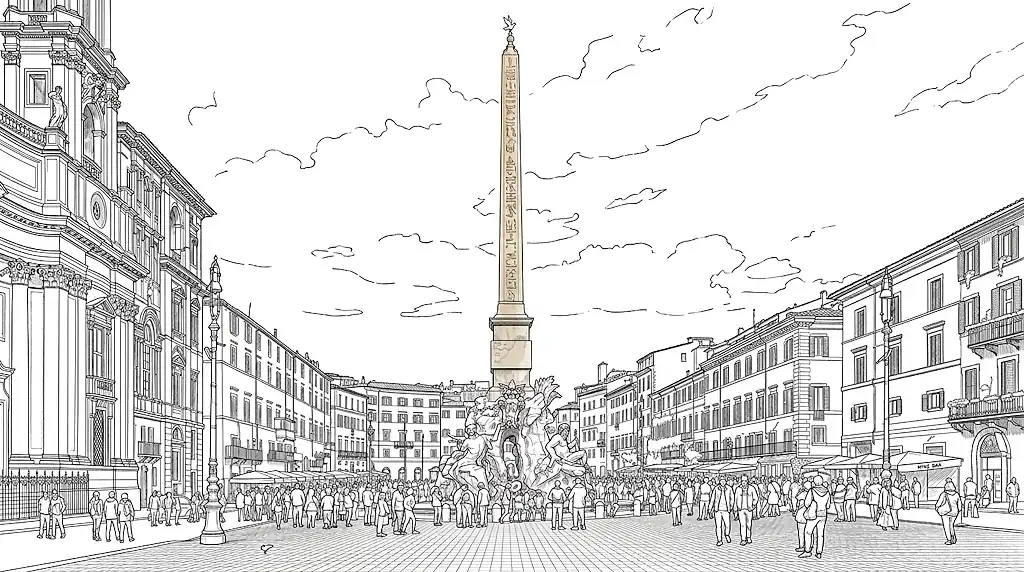
Among the most famous is the Agonale Obelisk (16.54 m, 30.17 m with the fountain), crowning Bernini's Fontana dei Fiumi in Piazza Navona (1651), positioned over the site of the Stadium of Domitian. It features the curious distinction of being decorated with "fake" hieroglyphs copied with grammatical errors by Roman stonemasons - a learned but imprecise quotation.
Equally "Egyptian-style" is the Sallustiano Obelisk (13.91 m) atop the staircase of Piazza di Spagna / Trinità dei Monti, originally placed in the Horti Sallustiani (1st century AD) and erected in its current location only in 1789.
The obelisk in the Pincian Gardens is a Roman reproduction from the era of Hadrian (118-138 AD), made in honour of the imperial favourite Antinous, a young Greek deified after his death. Two uninscribed twin obelisks once decorated the Mausoleum of Augustus in the Campo Marzio: at the behest of Sixtus V, one now stands in Piazza dell'Esquilino (before the apse of Santa Maria Maggiore) and the other in Piazza del Quirinale, in front of the seat of the President of the Italian Republic.
The Axum Stele - The African Intruder
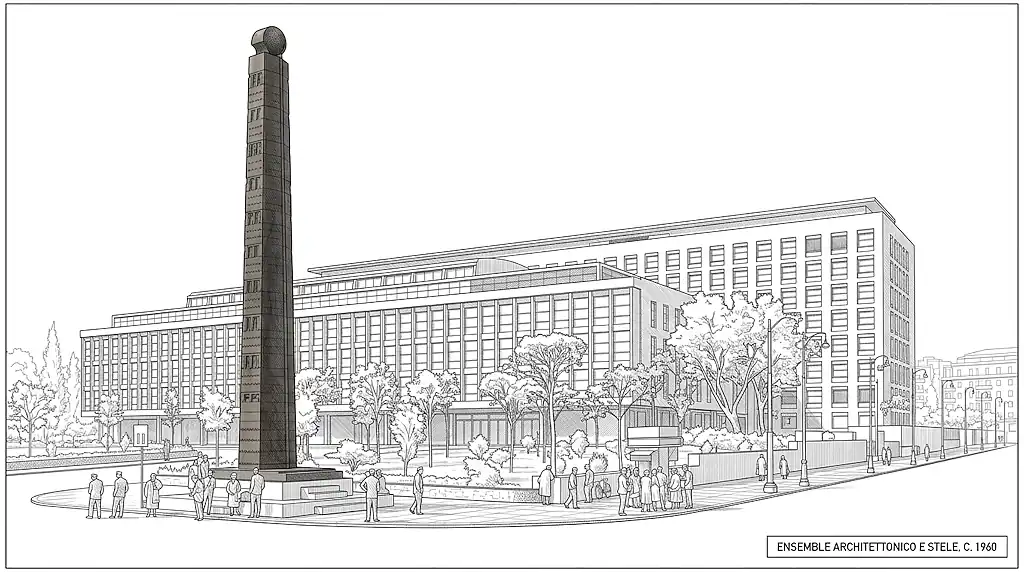
The thirteenth monument to have been part of Rome's skyline is also its most anomalous: neither Egyptian nor Roman, but Ethiopian. The Axum Stele is a funerary stele of dark basaltic stone, 24 metres tall and weighing approximately 160 tonnes, carved between the 3rd and 4th century AD by the people of the Kingdom of Aksum - one of the great civilisations of antiquity, a commercial crossroads between Africa, Arabia and the Mediterranean, and the first Christian kingdom in Africa.
Unlike Egyptian obelisks - sacred to the sun and the Pharaoh's divine majesty - the Aksumite stelae were funerary monuments, erected to mark the tombs of rulers and noblemen. Their surface reproduces architectural decorations of false doors and windows, as if the monument were the façade of a palace for the afterlife. Over a thousand were erected at Aksum, most of them still buried or destroyed.
The Twentieth-Century Obelisks: A Modern Legacy
Rome stopped being a passive spectator in the history of obelisks long before the twentieth century, but it is in the EUR district - that rationalist dream Mussolini envisioned for the 1942 World's Fair - that we find the city's two most significant modern spires.
The EUR district is home to two of the most imposing expressions of monumental sculpture in twentieth-century Rome.
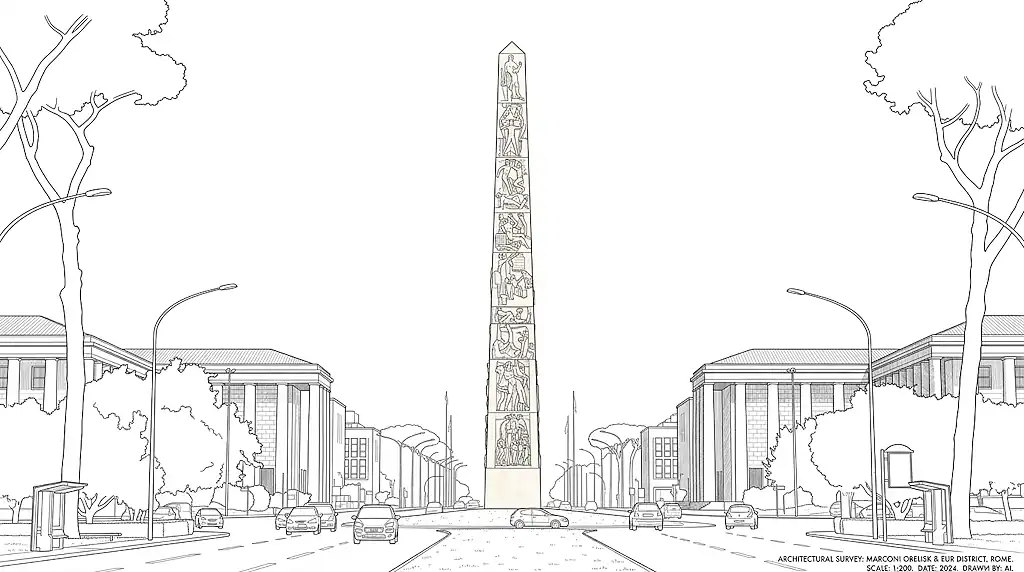
The first is the Guglielmo Marconi Obelisk, the visual centrepiece of the square that bears his name. This is no ordinary commemorative monument: the project was conceived as a petrified radio antenna, a sculptural tribute to the invention that had transformed global communications. Commissioned in 1939 by the Ministry of Popular Culture from the Carrarean sculptor Arturo Dazzi, the Carrara marble colossus reached its full height of 45 metres only on 12 December 1959 - twenty years after work began, interrupted by the Second World War and resumed only in anticipation of the 1960 Rome Olympics. The 92 relief panels covering the stele depict dances, songs, prayers and natural landscapes: a lyrical catalogue of the inventor's discoveries, with a visible stylistic shift between the panels of the 1940s - smooth and academic - and those of the 1950s, more expressive and textural.
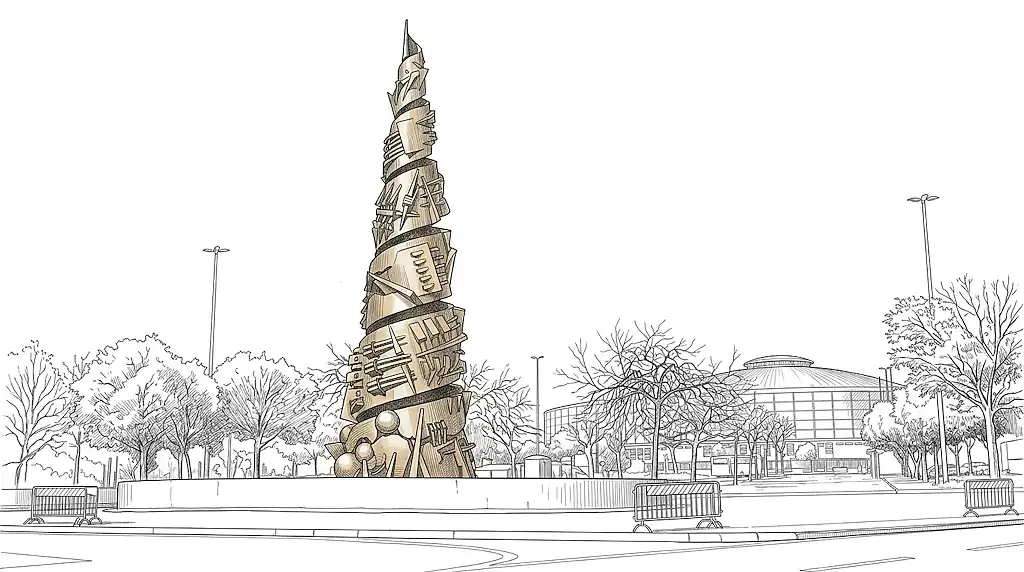
A few hundred metres away, in Piazzale Pier Luigi Nervi, stands the twenty-first century's answer to the myth of the spire: the "Novecento" Obelisk by Arnaldo Pomodoro, inaugurated on 23 October 2004 in the presence of Mayor Walter Veltroni. Commissioned by the City of Rome for the Jubilee of 2000, the bronze work rises to 21 metres in height and 7 metres in diameter at the base, for a total weight of 88 tonnes. It is not a cone but a growing spiral wound around a central cylindrical axis: the surface is broken by geometric solids, abstract figures, fractures and hollows that symbolise the contradictions of a dense and turbulent century. Inside, the structure is hollow and houses a scenic lighting system that accentuates its verticality after dark.
Discover Rome's Obelisks on a Private Tour
With Argiletum Tour, an expert guide will take you on a journey through Rome's most ancient monuments, weaving together Egyptian history, Imperial grandeur and Baroque urban planning.
Browse Private Tours in Rome Enquire Now