


It is around the First Century AD, and the capital of the Roman Empire, experiencing continuous demographic growth, is grappling with severe supply problems, especially during the winter months when transport becomes increasingly difficult. The river port of Ostia is no longer capable of meeting Rome's immense needs; the port of Pozzuoli, on the other hand, is too far from the capital to guarantee the continuity of supplies.
Julius Caesar had already hypothesized a new port for Rome, but it was Emperor Claudius who decided to build an artificial harbor about 3 km north of the mouth of the Tiber, used as a waterway for the transport of goods.
The project was not well received due to the enormous anticipated costs; furthermore, the dangerous proximity to the Tiber would soon lead to the accumulation of large quantities of soil and debris, compromising the functioning of the entire structure. Which, indeed, is exactly what regularly happened...
Claudius was not intimidated, and in 42 AD he began the construction of the new port, near the current Fiumicino international airport, starting with an artificial basin of 90 hectares excavated from a lagoon and enclosed by an immense breakwater 758 m long and 3 m wide.
The port of Claudius extended into the open sea with two long curved moles resembling a pincer. It was connected to the Tiber — the waterway for goods transport — via the artificial Fiumicino canal, completed in 46 AD with the formation of the Isola Sacra (Sacred Island).
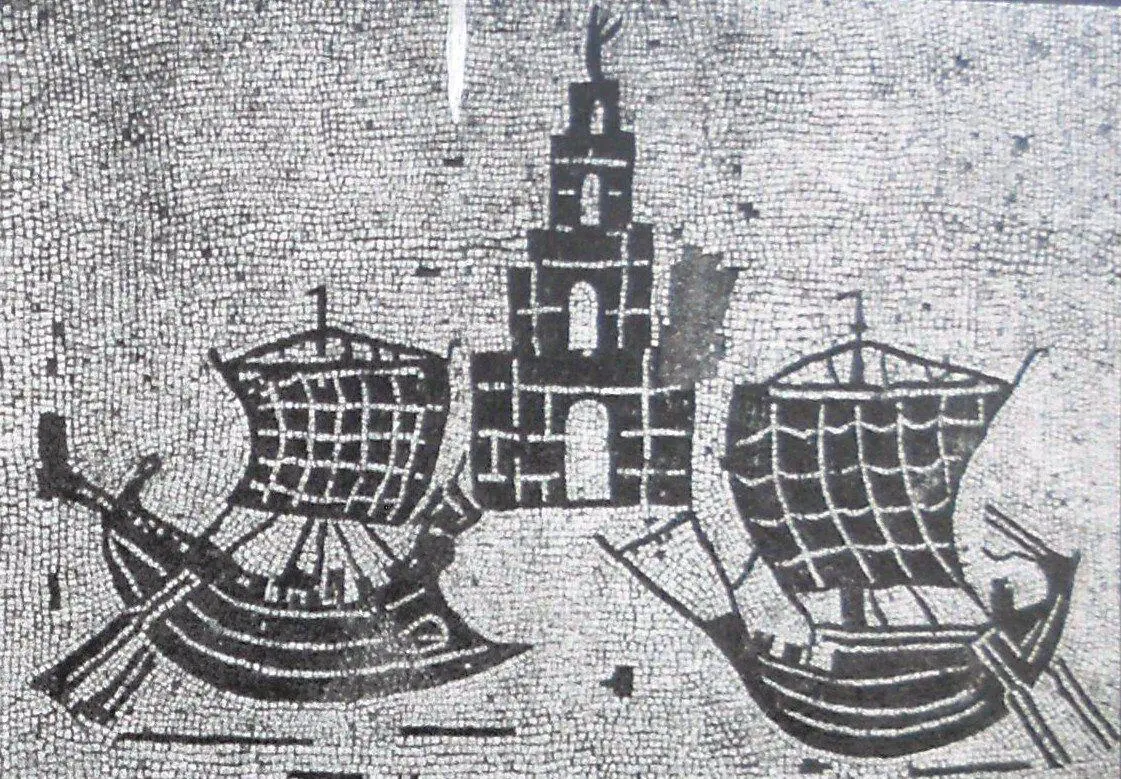
At the harbor's entrance stood a lighthouse — similar to the one at the port of Leptis Magna in present-day Libya — built on a small islet created by sinking the large decommissioned ship that had transported the obelisk for the Vatican Circus from Egypt, ballasting it with over 1000 tons of pozzolana.
The ship used to sink the foundations of the lighthouse was not just any vessel. Built by order of Caligula, it was so massive that it required 120,000 modii of lentils (about 1,000 tons) just to be ballasted and sunk. Pliny the Elder described it as a monster of the seas, so large that its mainmast was the tallest fir trunk ever seen in Rome. Sinking it was a spectacular engineering operation that required pozzolana, the Roman "reinforced concrete," capable of solidifying even underwater.
Portus, partially active in 62 AD, was completed by Nero in 64-66 AD. It is estimated that the monumental works required 30,000 workers and 1,000 pairs of oxen over 20 years. Docks and warehouses (horrea) were created on the two moles for trade and goods storage. Portus was connected to the city of Ostia, which in turn was linked to Rome via the Testaccio port on the Tiber (Emporium), ensuring the food supply to the city.
A settlement — Portus Ostiensis — developed near the complex, populated by workers, port administrators, and private entrepreneurs.
Burdened by the deposit of river sands, the new port quickly became impractical. Apart from the silting of the basin caused by the Tiber, the wind also highlighted the complex's unreliability, as the port was effectively in the open sea without natural shelters: Tacitus wrote that in 62 AD a storm sank about 200 merchant ships, while another hundred, which had taken shelter in the Tiber, were destroyed by a fire.
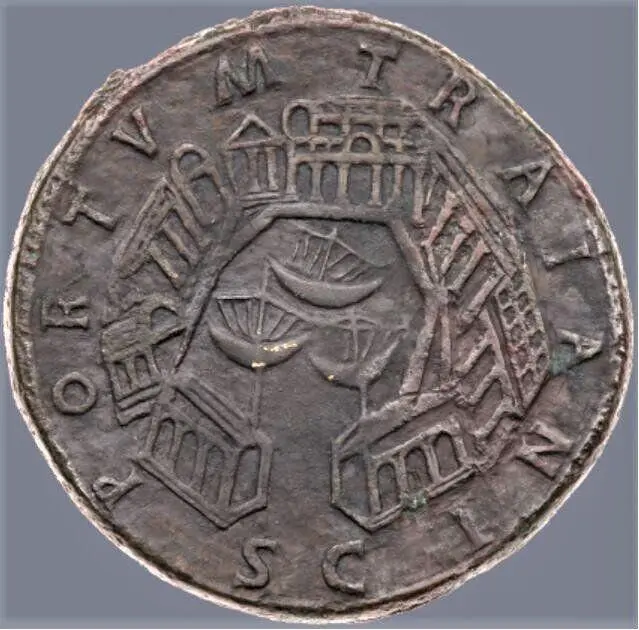
Under Emperor Trajan, the entire complex underwent restructuring with the construction of a second, more protected port, relegating the Port of Claudius to a mere roadstead shelter. The project was financed through the conquest of Dacia, which brought an impressive war booty into the Roman state coffers, with about 50,000 prisoners, 165 tons of gold, and 331 of silver.
The architect Apollodorus of Damascus did not choose the hexagonal shape for an aesthetic whim, but out of pure engineering brilliance. The hexagon maximized the perimeter of the docks (up to 2 km of continuous mooring) while minimizing the internal water surface. Less water meant fewer internal currents, greater protection from winds and, above all, less sand to constantly dredge. A mathematical and logistical miracle.
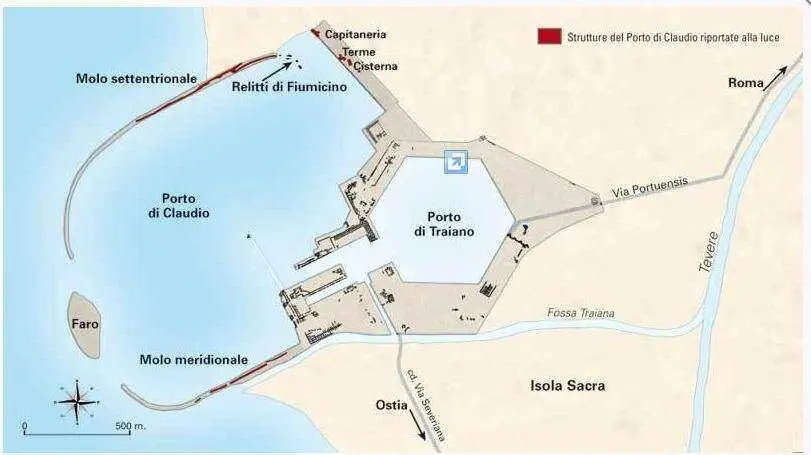
The new basin features a hexagonal layout suitable for the simultaneous execution of various naval operations: docking, loading, unloading, and transport of goods. The sides of the basin measure 358 meters and develop 2000 meters of quayside; the depth reaches 5 meters, the bottom is paved to allow easy maintenance, and the total area is about 32 hectares.
The Port of Trajan could hold up to 200 large-tonnage ships, which could dock and unload goods, soldiers, slaves, and animals from every part of the known world.
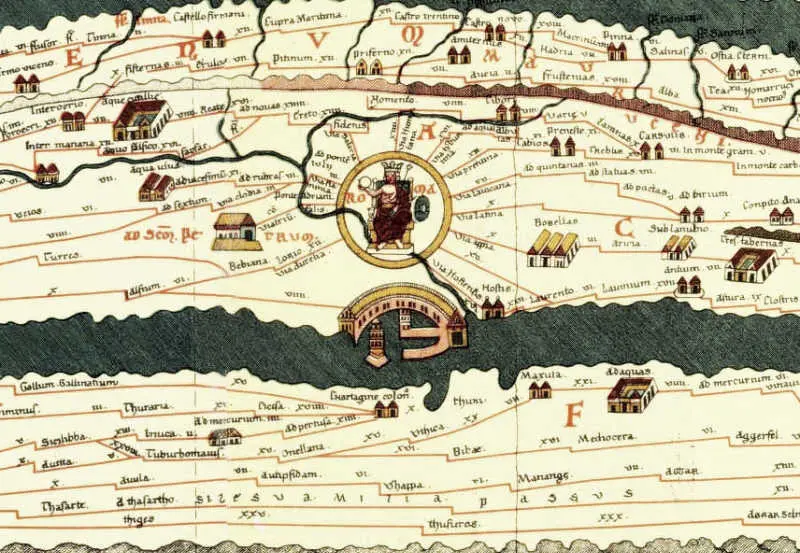
A system of canals (including the Fossa Traiana, today's Fiumicino canal), connected the port with the Tiber and thus with the capital. The Via Portuense also ensured the overland connection.
The restructuring of the complex was completed around 112 AD.
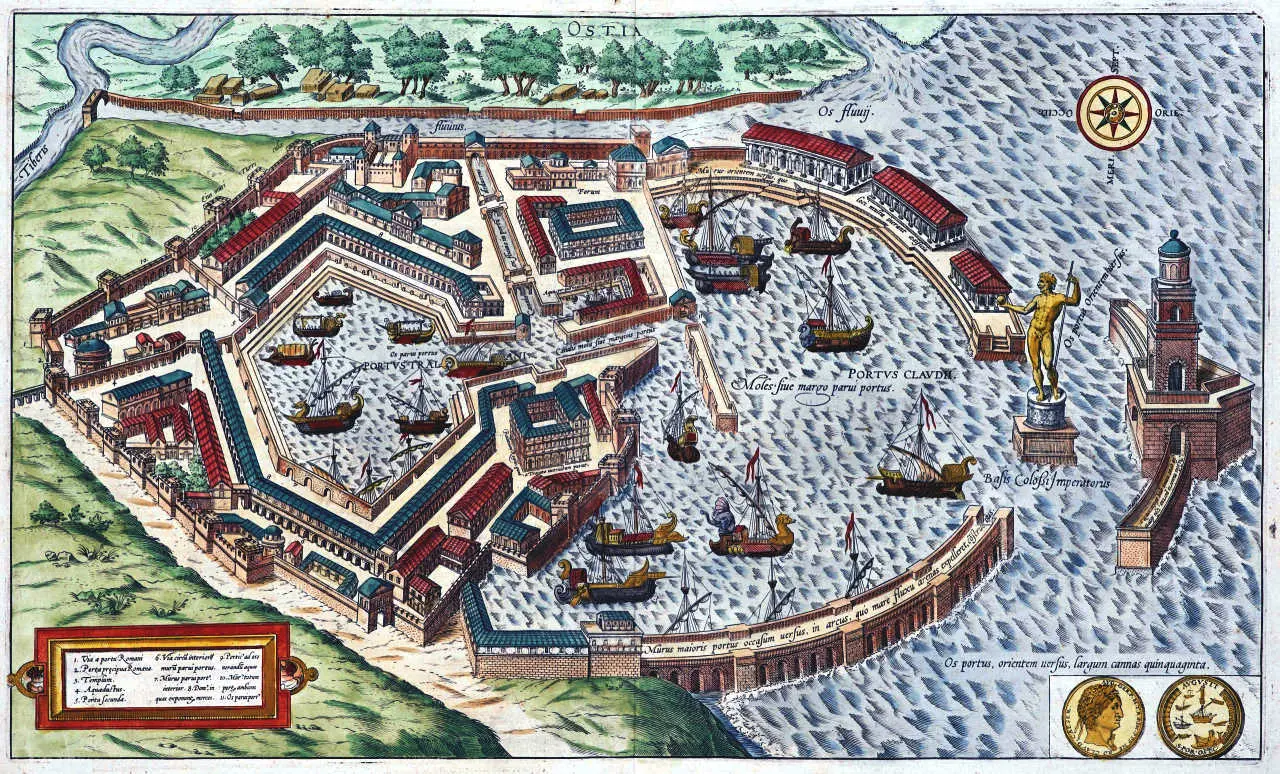
The port remained in operation for centuries, underwent multiple interventions, and acquired increasing importance, so much so that in 313 AD, under Constantine, Portus Romae obtained full autonomy.
Every ship docking at Portus carried tens of thousands of amphorae of oil, wine, and grain from all over the Mediterranean. Once emptied, commercial amphorae were not reusable. Where did they end up? They were broken into pieces and dumped in a specific spot in Rome. Those shards (*testae* in Latin) accumulated century after century until they created today's Monte Testaccio, a real artificial hill 35 meters high, composed of about 25 million amphorae coming largely from the warehouses of Portus.
It is estimated that Portus hosted, at its peak, a seasonal population of about 15,000: sailors, dockers, shipwrights, slaves, administrators, merchants, soldiers, and government agents, mostly commuting from Ostia or Rome. The estimated port traffic consisted of several thousand ships per year, and hundreds of smaller boats and barges in the various basins and canals or in the Tiber river.
In 408 AD Portus was sacked by Alaric's Goths (who destroyed Rome in 410), and in 455 it was partially damaged by Genseric's Vandals. The strategic relevance of the port facilities for Rome's supply, now limited only to Trajan's basin, and the danger of direct attacks led, at the end of the 5th century, to the construction of fortification walls around the port structure.
After the Gothic Wars (535-553), Portus progressively declined.
Where there once was a seaport, today stands an airport...
Today, the sea is about 3 km away from the Port of Claudius, which is now completely silted up.
The territory and the site of Portus were acquired by the Torlonia family in 1856, who brought to light some of the buildings. The hexagonal basin of the Port of Trajan, reduced to a swamp, was cleaned and restored in 1923. Subsequently, the transfer of part of the Torlonia property to the state allowed for the establishment of the Portus Archaeological Area, limited to the area of Hadrian's port alone.
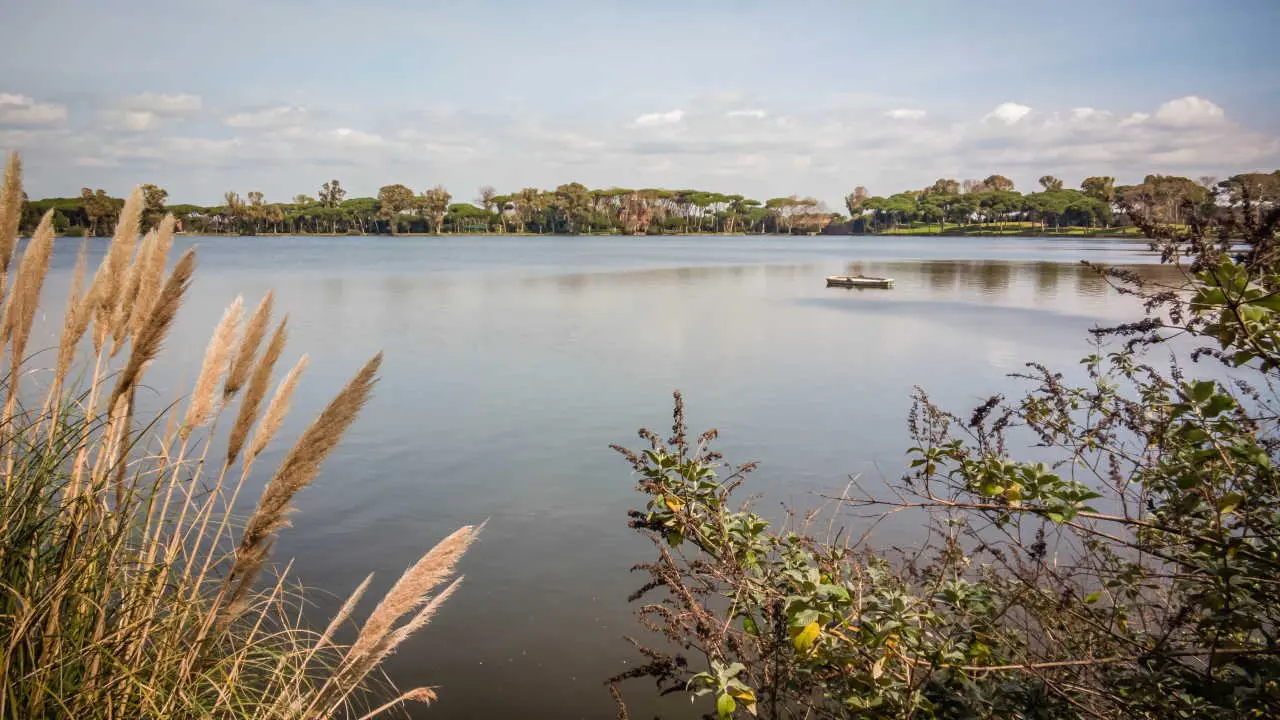
The entire hexagonal basin of Trajan, however, including the remains of the storage structures, is today a privately owned area called Oasi di Porto. The two distinct archaeological areas are open to the public and are located within the territory of the modern municipality of Fiumicino. It can be reached from Rome via the Rome-Fiumicino highway and the Via Portuense, and from Ostia and Fiumicino via the Via dell'Aeroporto.
The visit to the Oasis lasts about 1 hour and is done partly on foot and partly on horse-drawn carriages.
Visit Rome with Argiletum Tour, your local experts.
Guided walking or driving tours for couples, families, and small groups.
From discovering the Vatican Museums and the Sistine Chapel, to the Colosseum and the extensive archaeological area of the Roman Forums, the Borghese Gallery, architectural Squares and majestic Fountains, without forgetting Basilicas and Churches which, in Rome, often house exquisite works of art!
Contact Us