With this guide, you will discover the Colosseum not just as an extraordinary archaeological monument, but as a “living gateway” to understanding Roman greatness.
What you will find: how to visit this masterpiece, the latest excavations, fascinating stories, and tours that make each visit unforgettable.
Rome and its universal heritage
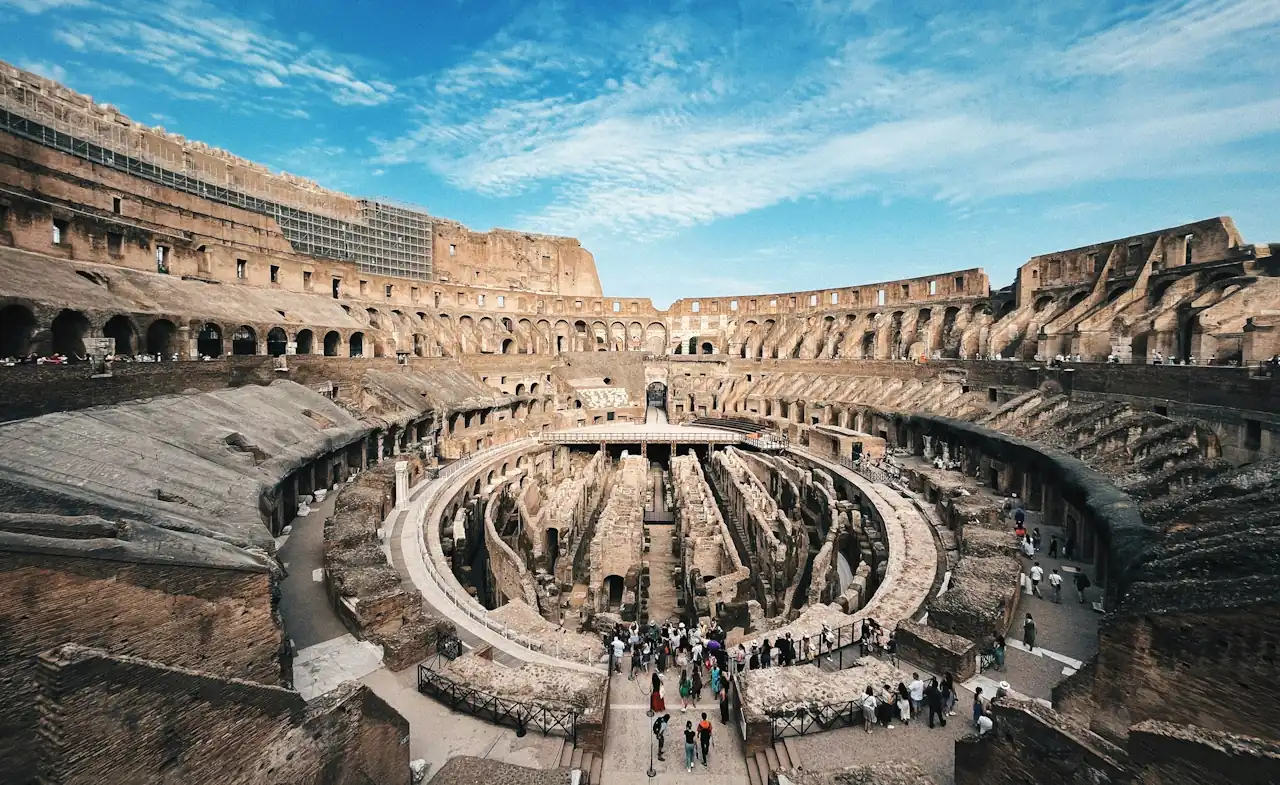
The first Sunday of every month, the Colosseum is open for free visits; however, without the possibility to book, the queue may be very long, especially during certain times of the year.
To avoid lines we recommend making a reservation.
Best Times: early in the morning (at 8:30 when it opens) or during lunch break (at 14:00) when tourist flow is lower.
Book a tour of the Colosseum: Argiletum Tour offers private tours at the Colosseum with skip-the-line access that includes a specialized archaeological guide. Our Colosseum and Ancient Rome tours allow you to explore the monument with expert guides, covering in about 3 hours the Colosseum, the Roman Forum, Palatine Hill, and the Imperial Fora.
Visit our Colosseum tour or contact us for customized itineraries.
New Hypogean Sections
An incredible new feature for visitors is the opening of new hypogean sections (underground) of the Colosseum. In 2025, the Archaeological Park of the Colosseum completed the museumization of a new portion of the hypogea, continuing an ambitious project to reinterpret the monument.
This new exhibition section allows for understanding the hypogean hydraulic systems of the amphitheater, uncovered through research conducted since 2022 in collaboration with “La Sapienza” University of Rome, the Department of Ancient Sciences, and private structures specialized in restoration.
The Harbingers
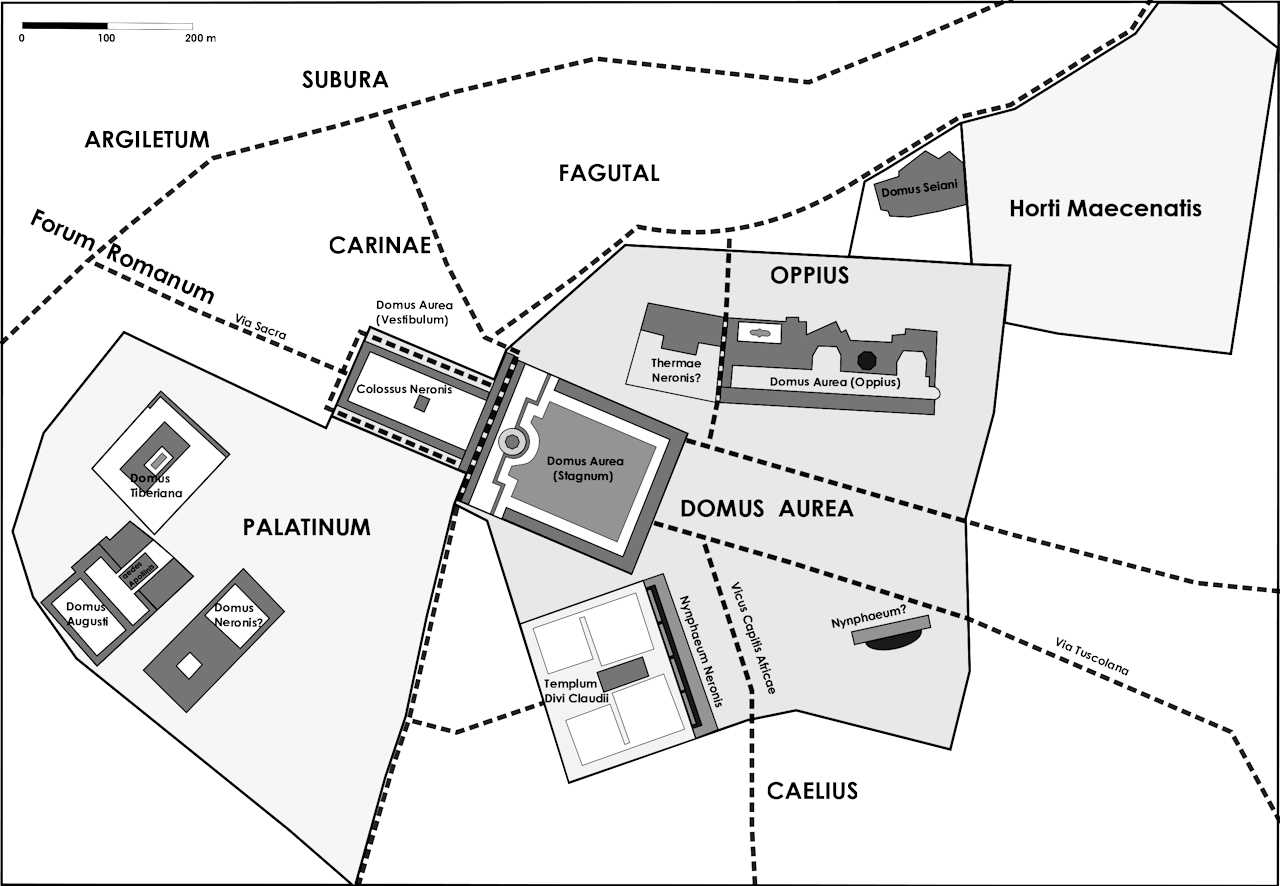
To understand the Colosseum, one must start with Nero and his infamous Domus Aurea (“Golden House”), the imperial palace built after the great fire of Rome in 64 A.D.
Read our article on the Domus Aurea
The eccentric emperor (37-68 A.D.) drained a vast area between the Palatine, Esquiline, and Caelian hills, creating an artificial lake (stagnum) of extraordinary beauty, surrounded by paradise-like gardens, woods, vineyards, and architectural wonders. According to the poet Martial, a contemporary of Nero, the Domus Aurea was such a grand structure that it would take an entire generation to visit it completely.
However, Nero’s reign ended dramatically in 68 A.D. with his death (officially suicide), followed by a period of political instability. When Titus Flavius Vespasian came to power in 70 A.D., he recognized the popular discontent: the lands of the Domus Aurea, hastily taken by the nobility, had heightened the resentment of the Roman populace.
Return the Space to the People

The decision of Vespasian to construct a public amphitheater open to all on the location of Nero’s pond was a masterful political strategy. By symbolically dismantling the oppressive palace and restoring that area to the populace, the emperor won the support of the citizens while honoring military achievements: the funds derived from the plunder of the Temple of Jerusalem (70 AD), when his son Titus’s forces captured the Judean city during the Jewish uprising, financed the project.
Construction began between 70 and 71 AD and took just 9 years to finish, an impressive achievement given its scale and intricacy.
The Triumphal Inauguration (80 AD)
Vespasian passed away in 79 AD without witnessing the completion of the monument. It was his son Titus who officially inaugurated the amphitheater on April 21, 80 AD, celebrating with 100 days of non-stop games featuring 5,000 wild animals (lions, tigers, rhinoceroses, giraffes, elephants), gladiators, pirate ships (for naval battles in the flooded arena), and even the execution of Christians turned into spectacles.
These games were financed with enormous amounts of money and epitomized the peak of Roman imperial authority. Martial chronicled the events in his poems, illustrating how the arena was transformed into a sea with real ships engaging in battle, while the spectators experienced displays of extraordinary grandeur.
The Completion under Domitian
Additional modifications and final touches were completed under Domitian (81-96 AD), the final emperor of the Flavian dynasty, who incorporated significant structural enhancements, particularly in the hypogean (subterranean) systems and the creation of the Meta Sudans (a fountain shaped like a pyramid nearby).
Flavian Amphitheater

The Flavian Amphitheater (official name of the Colosseum) is a remarkable structure of astounding scale:
It was the largest amphitheater of the ancient world and remains so to this day.
The Structure: Orders and Organization
The amphitheater was divided into four concentric orders (levels), reflecting the rigid social hierarchy of Rome:
| Order | Position | Usage |
| I Order | First level, close to the arena | Senators, magistrates, priests |
| II Order | Second level | Nobles and wealthy citizens |
| III Order | Third level | Middle-ranking citizens |
| IV Order | Highest level | Women of any rank, slaves, commoners |
Colosseum Orders and Their Social Destinations
Each section was accessible through separate corridors (vomitoria), allowing the entire amphitheater to be evacuated in a matter of minutes – a masterpiece of logistical organization.
The Arena and the Underground
The arena (from Latin “harena”, meaning sand) was a wooden platform covered with sand, containing sophisticated hypogeal systems that fascinated the ancient Romans. Beneath the arena, there were:
Recent research (2022-2025) has revealed the extraordinary complexity of these systems, with traces of sophisticated water management and evidence of animal conservation.
Materials and Construction Techniques
The Colosseum was built with remarkable technological innovation:
The quality of Roman concrete was such that some internal sections remain intact after nearly 2,000 years.
The Facade and Architectural Orders
Externally, the Colosseum featured a composition of four stacked orders:
Between the columns, numerous archways (80 total on the outer perimeter) opened, each provided with a stone vault. The facade was entirely covered with shining travertine marble, an impressive statement of imperial power.
The Inaugural Games: 100 Days of Shows

The inauguration of 80 A.D. under Titus was an unprecedented event. The games lasted for 100 consecutive days and represented the peak of Roman organization. The chronicles describe:
Gladiators, Beastfighters, and Hunters
The Gladiators
Gladiators were fighters – slaves, condemned criminals, or occasionally free men who chose the profession for profit – who faced each other in ritual duels. Their lives followed a strict code:
One of the most famous gladiators was Spartacus, who, although he died before the opening of the Colosseum, inspired the legendary revolt of 73-71 B.C. against Roman oppression.
The Beastfighters and Hunters
Beastfighters were specialists who fought wild animals, often with fatal results. Their fights were considered more spectacular than gladiatorial duels, especially when they faced lions or tigers.
The Sacrificed Victims
Modern research has revealed that not only criminals and slaves but also early Christians were publicly executed in the Colosseum. Although Christian tradition has exaggerated the numbers, it is historically established that the Colosseum was the site of persecution during the reigns of Nero and his successors.
The Daily Life of the Monument (80-500 A.D.)
For about four centuries, the Colosseum remained the center of public life in Rome, with games not only during inaugurations but also on religious festivals, imperial anniversaries, and military celebrations.
However, with the decline of the Roman Empire, the frequency of games diminished. With the adoption of Christianity in the 4th century A.D., the practice of gladiatorial combat was gradually banned, although animal shows continued for some time.
In 410 A.D., when the Visigoths under Alaric sacked Rome, the Colosseum suffered significant damage. Subsequently, with the final collapse of the Western Roman Empire in 476 A.D., the monument fell into neglect and was slowly stripped for its materials.
REDISCOVERY AND ENHANCEMENT
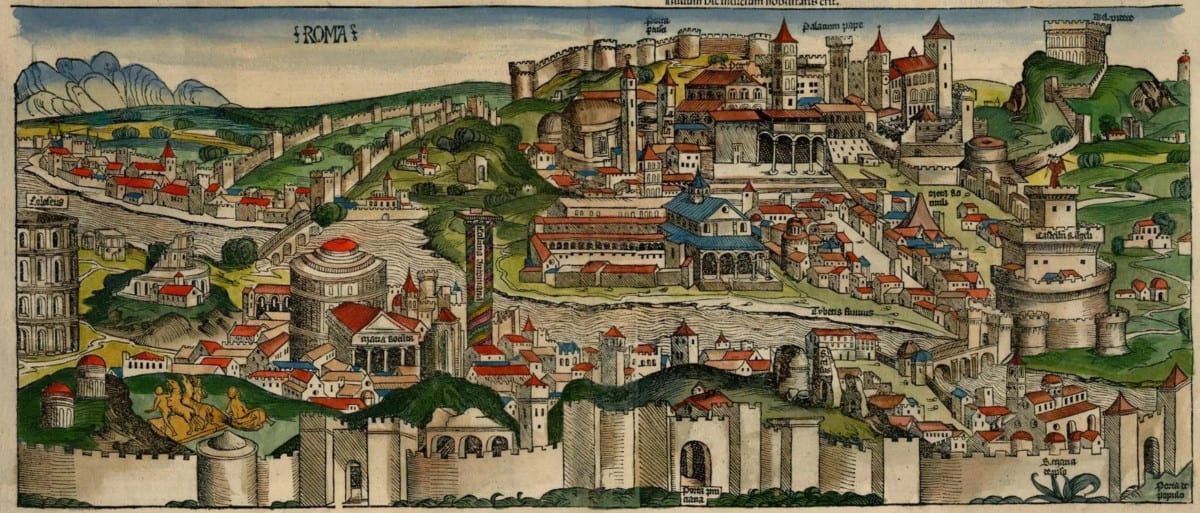
During the Middle Ages, the Colosseum became a quarry for materials. Marble, travertine, and iron were systematically extracted to build churches, noble palaces, and other structures of medieval Rome. The structure further deteriorated due to frequent earthquakes, particularly those in the 12th and 16th centuries.
It was the Renaissance that rekindled interest in the monument. Artists like Michelangelo and Raphael studied the ruins of the Colosseum alongside other ancient structures, drawing inspiration for their creations.
In 1744, Pope Benedict XIV declared the Colosseum a consecrated place, protecting it from further plundering. The building was also dedicated to the Christian martyrs who were believed to have been killed in the monument.
Modern Era: Archaeological Excavations and Preservation
Systematic archaeological excavations began in the 19th century, particularly under the patronage of the Papal Government and later the Italian State. By 1913, the Colosseum was fully acquired by the Italian State.
Significant excavation and restoration campaigns have taken place in the 20th and 21st centuries, uncovering:
International Recognitions
The Colosseum was listed as a UNESCO World Heritage Site in 1980, and in 2007 it was declared one of the New Seven Wonders of the World, confirming its status as the most iconic monument of Roman antiquity.
RECOMMENDED VISIT
The Complete Colosseum Experience with Argiletum Tour
For those looking for an in-depth guided experience of the monument, Argiletum Tour offers personalized and professional solutions.
Private Colosseum and Ancient Rome Tour
Our Private Colosseum and Ancient Rome Tour at your pace is specifically designed for those who want to truly understand the monument:
Duration: 3 hours
Departure: 9:30 AM or 2:00 PM (other times available upon request)
Included:
How to book: Visit our tour or contact us for customized itineraries.
THE COLOSSEUM

The Colosseum is much more than an impressive ruin. It is an open window onto the complexity of Roman civilization: its architectural grandeur, the sophistication of its engineering, the brutality of its public spectacles, and its extraordinary ability to turn death into entertainment.
Every stone of the Colosseum tells stories of ambitious emperors, courageous (or coerced) gladiators, exotic animals transported from Africa and Asia, and millions of spectators who for centuries witnessed scenes swinging between the sublime and the horrific.
Visiting the Colosseum with Argiletum Tour allows you to access these stories not as a hurried tourist, but as a mindful traveler, accompanied by passionate guides who transform the stones into living narratives.